Via @HNTweets
At Bunnie Studios.
Showing posts with label computers. Show all posts
Showing posts with label computers. Show all posts
Tuesday, January 01, 2013
Sunday, December 02, 2012
Taiwan engineers defeat limits of flash memory

by Nancy Owano at Phys.org. Via @physorg_com.
[Macronix] redesigned a flash memory chip to include onboard heaters to anneal small groups of memory cells. Applying a brief jolt of heat to a very restricted area within the chip (800 degrees C) returns the cell to a “good” state. They said that the process does not have to be run all that often. According to project member Hang‑Ting Lue, the annealing can be done infrequently and on one sector at a time while the device is inactive but still connected to the power source. It would not drain a cellphone battery, he added.
Macronix estimates that the flash memory cells could beat the 10,000 cycle limit by lasting for as much as for 100 million cycles
Saturday, November 24, 2012
Tuesday, July 03, 2012
Google and the Leap Second

Soon after the advent of ticking clocks, scientists observed that the time told by them (and now, much more accurate clocks), and the time told by the Earth's position were rarely exactly the same. It turns out that being on a revolving imperfect sphere floating in space, being reshaped by earthquakes and volcanic eruptions, and being dragged around by gravitational forces makes your rotation somewhat irregular. Who knew?
These fluctuations in Earth’s rotational speed mean that even very accurate clocks, like the atomic clocks used by global timekeeping services, occasionally have to be adjusted slightly to bring them in line with “solar time.” There have been 24 such adjustments, called “leap seconds,” since they were introduced in 1972. Their effect on technology has become more and more profound as people come to rely on fast, accurate and reliable technology.
Image credit: gunnar3000/Pond5.com
Saturday, June 23, 2012
Why we owe it all to Alan Turing
by Dan Crow on Gigaom.
…he, more than anyone, can be said to be the father of the computer. So what was his great insight? What is it he did that shaped our world so profoundly?
The Church-Turing Thesis has two very important implications.
First, it recognized the fundamental limitations of the system — for example, that there are some programs that are not computable by any machine.
But it was the second implication that was most profound: within its limitations, a Turing Machine can be programmed to run any piece of software. In fact, one of the programs that can be run on a Turing Machine is a simulation of a Turing Machine. And the simulated Turing Machine can itself run any program that a Turing Machine can run.
This is the genius of Turing’s work, his key insight. He has defined a “Universal Machine” — one that can run simulations so powerful they are themselves universal machines.
Sunday, May 27, 2012
Make mainframes, not war
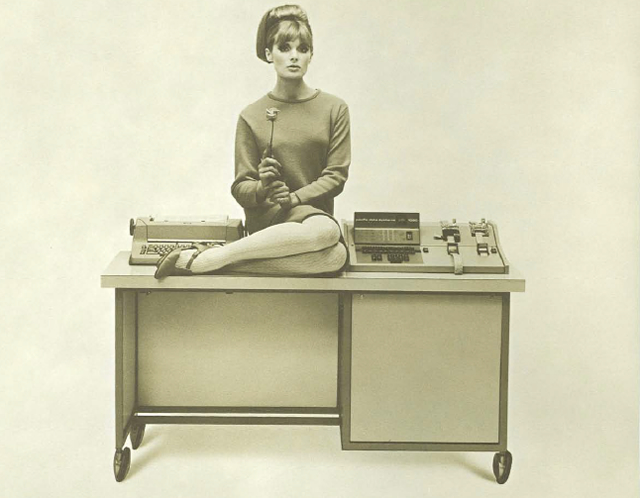
How Mad Men sold computers in the 1960s and 1970s by Matthew Lasar at Ars Technica.
Image credit: Computer History Museum
Monday, March 26, 2012
Andy Ihnatko's Ipad Review
At the Chicago Sun-Times, here's Andy Ihnatko's full review of the iPad.
My favorite line has nothing to do with the iPad: “Well, look, if you want your mind blown, go and watch the original Star Wars trilogy again while pondering the question ‘Is Artoo Detoo using The Force?’”
My favorite line has nothing to do with the iPad: “Well, look, if you want your mind blown, go and watch the original Star Wars trilogy again while pondering the question ‘Is Artoo Detoo using The Force?’”
Wednesday, March 07, 2012
Raspberry Pi
$35 and $25 mini computers. The Verge.
Uh, that's “mini” in a new, modern sense, not in the PDP-11 sense. I used to say that, soon, we'd have computers that you could actually lose. “Did you notice were I put the email server? I can't find it!”
Uh, that's “mini” in a new, modern sense, not in the PDP-11 sense. I used to say that, soon, we'd have computers that you could actually lose. “Did you notice were I put the email server? I can't find it!”
Tuesday, December 27, 2011
Thursday, December 22, 2011
Monday, November 14, 2011
Amazon Kindle Fire
reviewed at The @Verge by Joshua Topolsky.
Knocks aside, I do like the general aesthetic and feel of the Fire. After using this device and then going back to the iPad 2, I was struck at how big and bulky Apple's tablet feels. This size and shape might very well be the sweet spot for many users, and since most people have never seen or used a PlayBook, the Fire should be a relatively new experience for them from a design standpoint too.
Minor complaints aside, my main takeaway from the Fire on the process of finding and purchasing content is this: Amazon has done it better and more elegantly than anyone else in the space right now, and I hope the competition follows suit.
There are some bright spots, like the use of tabs, but overall I was underwhelmed with browser performance.
Furthermore, because the Fire is on Android 2.3, many of the applications offered feel like glorified phone apps. That works sometimes, but often it feels clunky and cheap.
Tuesday, October 04, 2011
The Knowledge Navigator was set in 2011
@arnoldkim RT. [VIDEO] I was quite taken with this Apple video that came out in 1987. At Emory, Jim will remember, we used to show it to freshmen during their computer technology orientation.
(An article is cited from 2006 as “five years ago.”)
(An article is cited from 2006 as “five years ago.”)
Thursday, September 29, 2011

I'm a Mac?
I'm trying an experiment. For the first time in longer than I can remember (probably the first time since the Mac II (series) in the very early 90s, I'm trying switching to a Macintosh as my main desktop system at home.
I've had a Macbook Pro of some flavor or another from work for five years now, so the Mac OS X environment is no stranger. Also, everyone else in the household has a Macbook.
But, for almost 10 years, when I sit down at my desk to do something serious, it's been the old Dell running Windows XP. Now, mainly pushed by the growing Gmail app, I'm faced with needing to add more memory to the old Dell but I'm tempted to make the jump to a more modern OS.
Around 2007 I made a solid decision. I'd never move to Windows Vista. In the same way that Windows 95 was a clear win and I abandoned the Mac interface, thinking it was for good (note that I had been a Windows user simultaneously all along and was using various UNIX workstations as well), it was just as clear that Vista was as horrible a mistake.
To be fair, Windows 7 seems to have redeemed the design and Windows 8 looks very interesting but the jury is still out. However, for now, I still have no intention of using a Windows machine, at least as my main workspace, every again. I still reserve the right to later change my mind, just like I did with the return to the Mac world, when a new boss suggested I really use a Macbook.
So, I finally decided to take the plunge that I've been considering for a while. I'm using my daughter's abandoned white 2007 Macbook as a desktop machine, plugged into my LCD monitor, keyboard, mouse and speakers.
Parents of college students and high school seniors take note. I wondered if the Macbooks would last a full four years, including the battery remaining functional enough, etc. The answer for us is Yes! The Macbooks can easily hold solid for a full four years of use. I think the aluminum Macbooks even more so.
This is in contrast to my observations of other laptops. Their batteries seem to barely work for more than a year or two and I usually see the whole laptop being replaced in from one to three years, i.e., you'll be buying two traditional Windows laptops for a four+ year undergraduate degree run. Factor that into the price/cost/value comparisons: A Macbook for school is worth two non-Mac laptops.
I should also point out that I always have an Ubuntu Linux workstation nearby including on my desk and I still find them extremely functional and sometimes even delightful to use. If I had to use Ubuntu for my daily environment, I think I could.
Also, rest assured, the old XP machine is still humming away right here, still plugged into the same monitor. I still miss the nicer looking, more pleasing fonts of the Windows XP GUI compared to the slightly too-weighty sans serif fonts of the Mac. But, I'm making that compromise to move on.
Next on the radar: Upgrading from Mac OS X 10.6 Snow Leopard to 10.7 OS Lion. Do I make that plunge? I'm intrigued by this new OS.
I've had a Macbook Pro of some flavor or another from work for five years now, so the Mac OS X environment is no stranger. Also, everyone else in the household has a Macbook.
But, for almost 10 years, when I sit down at my desk to do something serious, it's been the old Dell running Windows XP. Now, mainly pushed by the growing Gmail app, I'm faced with needing to add more memory to the old Dell but I'm tempted to make the jump to a more modern OS.
Around 2007 I made a solid decision. I'd never move to Windows Vista. In the same way that Windows 95 was a clear win and I abandoned the Mac interface, thinking it was for good (note that I had been a Windows user simultaneously all along and was using various UNIX workstations as well), it was just as clear that Vista was as horrible a mistake.
To be fair, Windows 7 seems to have redeemed the design and Windows 8 looks very interesting but the jury is still out. However, for now, I still have no intention of using a Windows machine, at least as my main workspace, every again. I still reserve the right to later change my mind, just like I did with the return to the Mac world, when a new boss suggested I really use a Macbook.
So, I finally decided to take the plunge that I've been considering for a while. I'm using my daughter's abandoned white 2007 Macbook as a desktop machine, plugged into my LCD monitor, keyboard, mouse and speakers.
Parents of college students and high school seniors take note. I wondered if the Macbooks would last a full four years, including the battery remaining functional enough, etc. The answer for us is Yes! The Macbooks can easily hold solid for a full four years of use. I think the aluminum Macbooks even more so.
This is in contrast to my observations of other laptops. Their batteries seem to barely work for more than a year or two and I usually see the whole laptop being replaced in from one to three years, i.e., you'll be buying two traditional Windows laptops for a four+ year undergraduate degree run. Factor that into the price/cost/value comparisons: A Macbook for school is worth two non-Mac laptops.
I should also point out that I always have an Ubuntu Linux workstation nearby including on my desk and I still find them extremely functional and sometimes even delightful to use. If I had to use Ubuntu for my daily environment, I think I could.
Also, rest assured, the old XP machine is still humming away right here, still plugged into the same monitor. I still miss the nicer looking, more pleasing fonts of the Windows XP GUI compared to the slightly too-weighty sans serif fonts of the Mac. But, I'm making that compromise to move on.
Next on the radar: Upgrading from Mac OS X 10.6 Snow Leopard to 10.7 OS Lion. Do I make that plunge? I'm intrigued by this new OS.
Tuesday, September 20, 2011
Computer CPUs 1000x Faster
At Mashable by Charlie White.
“…3M and IBM have unlocked a secret low-tech shortcut.”
“It’s an adhesive that dissipates heat so efficiently that layer upon layer of chips can be stacked on top of each other into silicon ‘towers’ up to 100 layers high, glued together with this special adhesive that keeps things cool. The result? Faster chips for computers, laptops, smartphones and anything else that uses microprocessors.”
“…3M and IBM have unlocked a secret low-tech shortcut.”
“It’s an adhesive that dissipates heat so efficiently that layer upon layer of chips can be stacked on top of each other into silicon ‘towers’ up to 100 layers high, glued together with this special adhesive that keeps things cool. The result? Faster chips for computers, laptops, smartphones and anything else that uses microprocessors.”
Thursday, September 01, 2011
It's Time To Upgrade My RAM
It looks like I'm going to have to add memory to my nine-year-old Dell 4550 Windows XP desktop which I'm using here and which is my usual desktop machine at home. Right now it has 768 MB but watching Task Manager it seems lately that I need from 800 MB to 900 MB with the number of Chrome tabs I have open for Gmail, documents, etc. Amazon Cloud player is currently running. In spite of a growing RAM appetite, I haven't seen my old machine cross 1-GB yet (knock on wood).
It has a 256-MB DIMM and a 512-MB DIMM so I'll probably just replace the 256 with a 1-GB which seem to be available for $15 to <~ $20 or so. That will bring the total to 1.5 GB, over twice what I currently need.
I think Gmail and other Google apps are slowly using more and more memory. But maybe it's just Chrome.
It's worth noting that, even with 930 MB of memory usage (commit charge), which is what it is at this very moment as I type this, I don't really notice the paging or much slowness. Typing this entry is going fine and the Cloud Player music is playing nicely. However, I'd definitely notice it if switching to another tab that hadn't been used in a while or, worst of all, trying to fire up something else that's big like Acrobat Reader.
Hm, I don't think it was that long ago that I upped the RAM from 384 MB by replacing a 128-MB DIMM with the 512-MB. Memory usage seems to be accelerating.
In case anyone is curious, the only thing running down in my system tray is AVG and something from Nvidia for the video interface.
It has a 256-MB DIMM and a 512-MB DIMM so I'll probably just replace the 256 with a 1-GB which seem to be available for $15 to <~ $20 or so. That will bring the total to 1.5 GB, over twice what I currently need.
I think Gmail and other Google apps are slowly using more and more memory. But maybe it's just Chrome.
It's worth noting that, even with 930 MB of memory usage (commit charge), which is what it is at this very moment as I type this, I don't really notice the paging or much slowness. Typing this entry is going fine and the Cloud Player music is playing nicely. However, I'd definitely notice it if switching to another tab that hadn't been used in a while or, worst of all, trying to fire up something else that's big like Acrobat Reader.
Hm, I don't think it was that long ago that I upped the RAM from 384 MB by replacing a 128-MB DIMM with the 512-MB. Memory usage seems to be accelerating.
In case anyone is curious, the only thing running down in my system tray is AVG and something from Nvidia for the video interface.
Thursday, July 28, 2011
Friday, May 06, 2011
Paper Computers
I remember an interview with someone from Xerox PARC, probably almost 30 years ago, where they were talking about ubiquitous computers that were like paper. I remember a quote that went something like, You'd just tear a new computer off a pad when you needed one. They'd just be laying around your office in piles.
Well, they seem to be here, as reported in this article in The Economic Times.
Well, they seem to be here, as reported in this article in The Economic Times.
Tuesday, March 29, 2011
YADC: The Deathstar
A [VIDEO] tour of Lucasfilm's/ILM's data center by Greg Grusby of ILM, blogged by Arik Hesseldahl and via Data Center Knowledge. (YADC: yet another data center). It is interesting to see him point out the old machines they used for Star Wars Episodes 1–3.
Saturday, March 12, 2011
Subscribe to:
Posts (Atom)