Showing posts with label astronomy. Show all posts
Saturday, May 18, 2013
Helioseismology from Kepler
In light of the Kepler space observatory's malfunction, which may bring the mission to an early end, here's a nice overview of some of Kepler's contribution to stellar astrophysics from Sky and Telescope.
A 90-Second Image of M13
From @makapala
Amazing! 90 seconds!
@darkskyman took this 90 second snap of M13 at @TheAstroCamp a few weeks back http://flic.kr/p/ehSg4U
Amazing! 90 seconds!
Monday, May 13, 2013
The Moon Over Andromeda
One of my favorite bits of information about the sky is how HUGE the Andromeda Galaxy (M31) is. The thing about galaxies is that they are terribly dim. Think about it. We're inside the Milkly Way galaxy and yet, except for the nearby bright stars, we can barely see it unless we go to the darkest spot we can find.
In fact, the apparent size of Andromeda is serveral times the apparent size of the moon. This photo where the moon is superimposed shows this clearly.
Even when you do see M31 with the naked eye, which you can from a dark location, it doesn't look this big. Objects have to be bright to look large. In the same way, the Pleides is much larger than the moon, but they look tiny on the sky.
http://www.noao.edu/image_gallery/html/im0606.html
Image credit: REU program, N.A.Sharp/NOAO/AURA/NSF
Thursday, December 27, 2012
Some Amazing Astronomical Images of 2012
Via @wired
I won't go as far as Wired's title, Best Space Photos of the Year 2012 in the article by Adam Mann, but these are amazing images.
For amazing astronomical images, one every day, see Astronomy Picture of the Day (APOD).
This image credit: ESO/B. Bailleul
Friday, December 21, 2012
Shortest Day of the Year
So is 2012-12-21 the shortest day of the year? The actual solstice occurs at different times in different years so I expect this varies. For this year, looking at the web site timeanddate.com (two d's), which I found via Google… (Sigh, the power just went out again!)
…It looks like it's actually 21 Dec, at least in Atlanta, GA. This snippet of their chart shows sun rise and set times, and the length of the day.
Happy Winter Solstice!
At 11:12 UTC, 6:12 EST, 3:12 PST.
Fri 2012-12-21 11:12:00 +0000
Fri 2012-12-21 06:12:00 -0500
Fri 2012-12-21 03:12:00 -0800
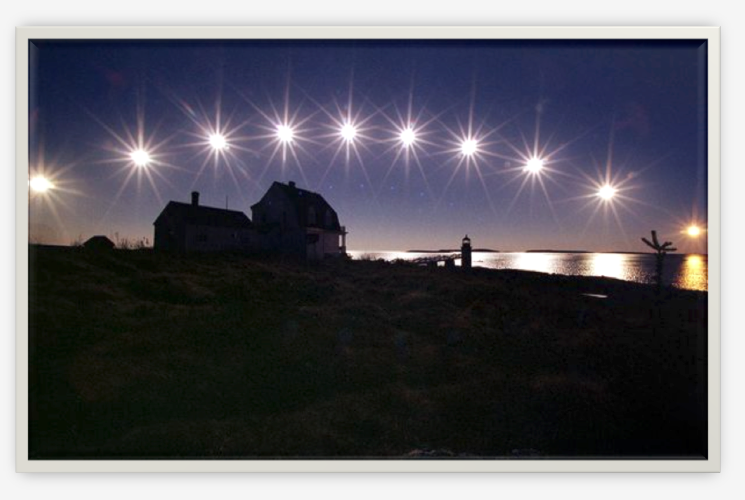
In the picture, the sun makes it lowest trek across the sky on the winter solstice. Winter officially begins.
Image credit: From NASA/NES Teachers Corner
Friday, December 14, 2012
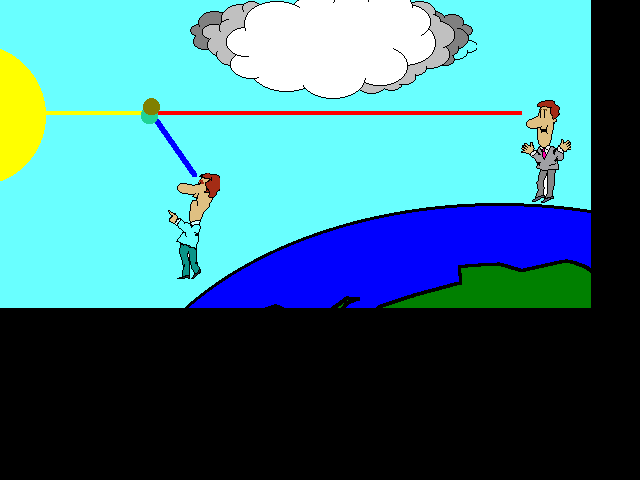
Why is the Sky Blue?
via @HNTweets
Original by Philip Gibbs May 1997. From Physics FAQ.
Why not violet?
If shorter wavelengths are scattered most strongly, then there is a puzzle as to why the sky does not appear violet, the colour with the shortest visible wavelength.
Sunday, December 02, 2012
See the Planet Mercury
Via @popastro. Society for Popular Astronomy.
Mercury reaches greatest western elongation on the 4th of December when it will rise about two hours before the Sun, shining at magnitude -0.5. Try to catch it for a few days around that date before it draws back towards the Sun again.
Venus is closing in on the Sun again too but still shining brilliantly at around magnitude -4 which makes it impossible to miss if you have a clear sky.
Saturn rises well before dawn at 4am at the start of December and nearly two hours earlier than that by the month’s end. Though much fainter than Venus, it is very bright at around magnitude 0.6. The planet’s spectacular rings are well open now making it a fine sight through a small telescope for early risers.
Image credit: Mercury, Venus and Saturn pictured on 2 December by Paul Sutherland
Friday, November 30, 2012
Biggest Black Hole?
Article by Elizabeth Howell for Space.com.
Via @mashable
Astronomers have discovered what may be the most massive black hole ever known in a small galaxy about 250 million light-years from Earth, scientists say.
The supermassive black hole has a mass equivalent to 17 billion suns and is located inside the galaxy NGC 1277 in the constellation Perseus. It makes up about 14 percent of its host galaxy’s mass, compared with the 0.1 percent a normal black hole would represent, scientists said.
UCLan Discovery Challenges the Cosmological Principle
From The University of Central Lancashire
Via @doccosmos
An international team led by academics from the University of Central Lancashire (UCLan) has found the largest known structure in the universe – a large quasar group that challenges scientific understanding of our universe.
The Cosmological Principle is the assumption that the universe, when viewed at a sufficiently large scale, looks the same no matter where you are observing it from.
Whole clusters of galaxies can be 2-3 Mpc across but LQGs [large quasar groups] can be 200 Mpc or more across. Although, based on the Cosmological Principle and the modern theory of cosmology, calculations suggest that astrophysicists should not be able to find a structure larger than 370 Mpc.
Saturday, November 24, 2012
Can You See A Star Die?

(Image Link (to zoom))
My sister-in-law asked me this excellent question the other night. I completely forgot about SN 1987A.
SN 1987A was a supernova in the outskirts of the Tarantula Nebula in the Large Magellanic Cloud, a nearby dwarf galaxy. It occurred approximately 51.4 kiloparsecs from Earth, approximately 168,000 light-years, close enough that it was visible to the naked eye. It could be seen from the Southern Hemisphere. It was the closest observed supernova since SN 1604, which occurred in the Milky Way itself. The light from the new supernova reached Earth on February 23, 1987.
Of course I didn't see this one because it was only visible in the Southern Hemisphere but I followed it pretty closely. As noted above, it was the first close supernova since A.D. 1604.
From the light curve you can see it took several months for the phenomenon to brighten and dim.
Friday, November 02, 2012
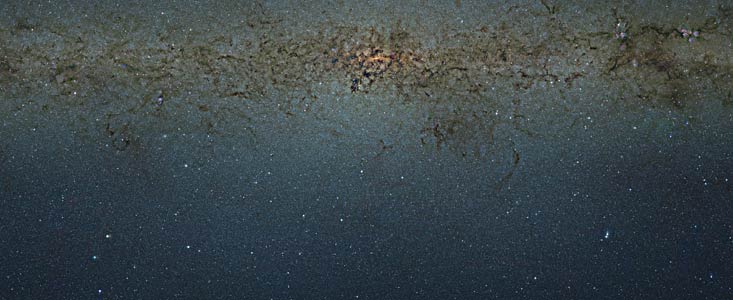
Nine Giga-pixel Image of the Milky Way
From The Verge.
Using images from the ESO's Visible and Infrared Survey Telescope for Astronomy (VISTA), researchers have stitched together a massive nine-gigapixel image of the Milky Way galaxy. The 108,200 x 81,500 image consists of nearly nine billion pixels, and was used to create a catalog of 84 million stars. Researchers claim that this is the largest image of its kind — the first to catalog the entire bulge of the Milky Way galaxy — and contains ten times more stars than any previous study.
My favorite part is where it says “Click to Enlarge.”
Sunday, October 28, 2012
Tuesday, October 23, 2012
Fireball - Meteorite Hits House in California
From Space.com.
Homeowner Lisa Webber, …found the space rock Saturday (Oct. 20)…. She recalled hearing a sound on her roof the night the meteor was reported and went searching behind her house, where she found a 2.2 ounce (63 grams) stone.
Tuesday, July 03, 2012
Amazing Star Trails
RT @matthiasrascher
Star trails over the Australian Outback by photographer Lincoln Harrison. http://t.co/4xqLJQun #photography #space
Thursday, June 07, 2012
My Favorite Venus Transit Video
It's pretty clear that NASA's Solar Dynamics Observatory (SDO) has stolen the show, at least on Youtube and Twitter, with it's videos of the recent Venus transit. However, my favorite video is not the popular, creepy (yet beautiful!) extreme ultraviolet images of a flat-looking black circle moving across amazing prominences and other features in the hot solar corona.
My favorite is this video in orange light where you can clearly see sunlight scattered around Venus' atmosphere as it moves in front of the Sun. The limb of the Sun also seems to be refracted by the planet's atmosphere.
These images were made by the SDO's Heliocentric and Magnetic Imager (HMI) which observes at a wavelength of an Fe I (unionized iron) absorption line at λ6173.
Tuesday, June 05, 2012
Live Stream of Venus Transit
There are several live streams of the Venus transit. Here's one from Mt. Wilson.
http://sunearthday.nasa.gov/webcasts/mtwilson/
Friday, June 01, 2012
Melancholia Misses the Physics
Melancholia was a dark and slightly depressing movie but with some interesting special effects. I watched it on a recommendation from Hal. However, they got the science wrong on a couple of basic accounts and I think I know why.
If a terrestrial planet (dirt and rock) came that close to the Earth, there would be two major effects. First, the tidal force on the Earth would be extreme. The Moon's diameter is more like the size of the United States and look at it's tidal force. Such an approaching big planet as the fictional Melancholia would basically put the Earth's surface through a food processor before any collision ever occurred. I'm not sure if the tidal force would be enough to completely destroy the Earth, but anything and anyone on or near the Earth wouldn't know the difference.
Tidal force is caused by the difference in gravitational force between the closest and farthest parts of one body caused by another. This effect of the Moon on the Earth causes it's ocean surface to bulge toward and away from the Moon. The Earth's crust also does the same but to a lesser and non-catastrophic extent.
Second, the two bodies would move about their mutual center of gravity. The Earth would be perturbed completely out of it's orbit by the encounter in some crazy way. It could still involve a single close encounter, again with both planets being destructively disturbed by the tidal forces of each on the other, followed by a later, final impact, but there's no telling what their mutual trajectory would look like. What is nearly certain is that the Earth would not continue on it's nearly-circular orbital path.
So surely they had a science/astronomical advisor for the movie. Why such fundamental mistakes? I propose that when they consulted their expert, they were thinking of a small asteroid collision with a body more the size of a large metropolis or a state. A small body wouldn't perturb the Earth from it's orbit and wouldn't have much tidal effect. However, the impact would be catastrophic.
Later, because they had brilliant ideas about the look and effect of a giant planet approach and final impact, they changed the threatening body but they didn't go back and consult the expert. They just kept the path from the previous discussions.
Sunday, May 27, 2012
A Deeper Look at Centaurus A
at Astronomy by By ESO, Garching, Germany.
The strange galaxy Centaurus A is pictured in a new image from the European Southern Observatory (ESO). With a total exposure time of more than 50 hours, this is probably the deepest view of this peculiar and spectacular object ever created. The image was produced by the Wide Field Imager (WFI) of the MPG/ESO 2.2-meter telescope at ESO’s La Silla Observatory in Chile.
Image credit: ESO
Sunday, May 20, 2012
Today's Solar Eclipse
It won't be visible from the Atlanta area, the sun will be setting at about the time of first contact. It will be visible farther to the west.
Article in Sky and Telescope
Image by NOAA/SEC
Subscribe to:
Posts (Atom)


.jpg)