Wednesday, March 07, 2012
The Bitcoin Story
I wondered where things are now with Bitcoin and went looking for a report. This story at Wired is pretty good.
Raspberry Pi
$35 and $25 mini computers. The Verge.
Uh, that's “mini” in a new, modern sense, not in the PDP-11 sense. I used to say that, soon, we'd have computers that you could actually lose. “Did you notice were I put the email server? I can't find it!”
Uh, that's “mini” in a new, modern sense, not in the PDP-11 sense. I used to say that, soon, we'd have computers that you could actually lose. “Did you notice were I put the email server? I can't find it!”
Radar images from the March 2012 tornado outbreak
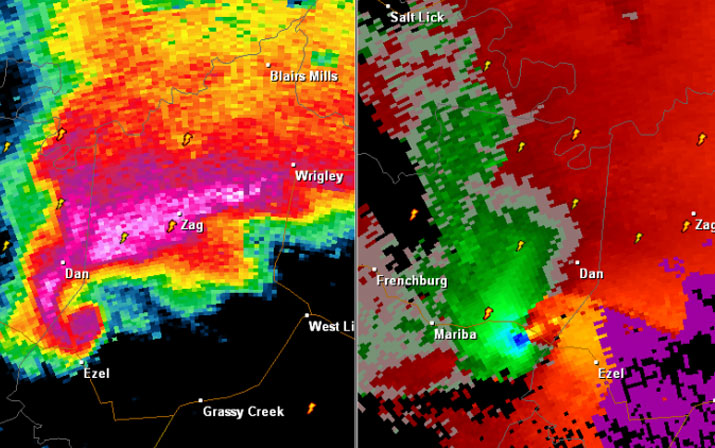
from United States Tornados. “a collection of a handful of the most gripping radar images of the March 2, 2012 storms as they were occurring.”
Solar Flare
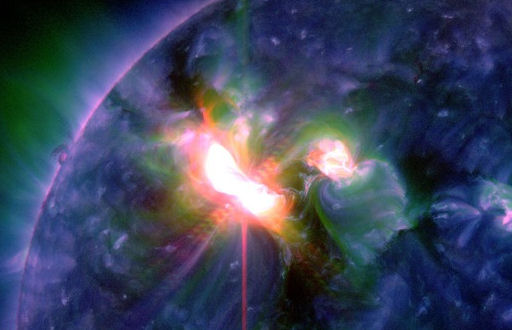
Watch for aurorae!
From Space Weather: “ Big sunspot AR1429 has unleashed another major flare. This one is the strongest yet, an X5-class eruption on March 7th at 00:28 UT. NASA's Solar Dynamics Observatory recorded the extreme UV flash”
And: “A coronal mass ejection (CME) hit Earth's magnetic field on March 7th at approximately 0400 UT. The impact was not a strong one, but it could stir up polar geomagnetic storms anyway. High-latitude sky watchers should be alert for auroras.”
From 11-Alive News.
Friday, February 17, 2012
Strings in Scheme Lisp
I was recently trying to find what string functions were built into Scheme. Yes, it actually is in the manual but my web search brought up this site: Python vs. Scheme: strings.
Spray-on Antennas
Using nano-particle capacitors. [Article at Discovery News]. I still don't know what to make of this—it feels somewhat like a hoax.
R-Like Statistics in Clojure
“Incanter is a Clojure-based, R-like platform for statistical computing and graphics.
Incanter can be used as a standalone, interactive data analysis environment or embedded within other analytics systems as a modular suite of libraries.” From incanter.org..
Monday, January 30, 2012
RT @ihnatko
I'm not saying that getting in a United economy seat is _exactly_ like squeezing into a Mercury spacecraft. But there are similarities. (From @ihnatko)
The 10 Best Android Arcade Games
From @mashable, in spite of the fact I despise these integer headlines.
ISS Flyover Video
More time lapse [VIDEO] from the International Space Station—flying over the earth.
Friday, January 27, 2012
Google’s Python Lessons are Awesome
via Hartley Brody
Google's Python class
The lovably geeky Nick Parlante — a Google employee and CS lecturer at Stanford — has written some awesomely succinct tutorials that not only tell you how you can use Python, but also how you should use Python. This makes them a fantastic resource, regardless of whether you’re just starting, or you’ve been working with Python for awhile.
Google's Python class
Tuesday, January 10, 2012
Don't Return Null
Use a Tail Call. This is a fascinating read, particularly if you follow the links.
Drone Data
I found this interesting from the article Counting on a Rush to the Cloud from Bits.
It reminds me of astronomers returning from a run at an observatory.
(One interesting side note: The cameras on drone aircraft in Afghanistan take such precise pictures that not all the data can quickly travel over the local Internet connections to analysts in the United States. The usual method is to store everything in a local cargo container full of receiving gear, computers and storage, then airlift it home when it’s full, swapping out another container to absorb more info from the drones.)
It reminds me of astronomers returning from a run at an observatory.
Thursday, January 05, 2012
Large Scale Design with Haskell
I'm revisiting the question, why and how is Haskell well-suited for large-scale projects? Here's one set of answers at Stack Overflow.
Monday, January 02, 2012
Saturday, December 31, 2011

Thursday, December 29, 2011
Wednesday, December 28, 2011
Haskell Authors
Simon Peyton-Jones and John Hughes interviewed at Channel 9.
The interview looks amateur but it gets more and more interesting as it progresses. Try to ignore the picture taking extravaganza that goes on in the background at one point.
Tuesday, December 27, 2011

Thursday, December 22, 2011
Earth's Rotation Measured!
Actually it's easier to think of this in terms of the wandering of the poles being measured. Story at Physorg.com.
Happy Winter Solstice!
At 0:30 EST last night (5:30 UTC).
Thu 2011-12-22 00:30:00 -0500
Thu 2011-12-22 05:30:00 +0000
These times are rounded to the minute, the seconds aren't really zeroes.
Thu 2011-12-22 00:30:00 -0500
Thu 2011-12-22 05:30:00 +0000
These times are rounded to the minute, the seconds aren't really zeroes.
Wednesday, December 14, 2011
Android vs. iPhone
Which looks better? This article in Business Insider says these 11 screen shots prove that “Android apps are uglier Than iOS apps.” I looked at them and I just don't see it. The Android apps don't look worse to me and I generally don't see what the captions of the various images assert.
I do see that the iOS apps look more consistent in some ways.
To me, many of the Android apps look cleaner. In one example the iOS app has a search box at top (taking up a lot of space) but I know Android has a search button that works in all apps (that I've experienced and that have search), so you don't need a search box always on screen.
In another case, the iOS app has letter-of-alphabet dividers for a list but I know on Android if you grab such a list and scroll a little tab appears. That tab has the current letter of the alphabet and you can quickly move it to the letter you're interested in, the list will scroll quickly as you move through the alphabet.
I do see that the iOS apps look more consistent in some ways.
To me, many of the Android apps look cleaner. In one example the iOS app has a search box at top (taking up a lot of space) but I know Android has a search button that works in all apps (that I've experienced and that have search), so you don't need a search box always on screen.
In another case, the iOS app has letter-of-alphabet dividers for a list but I know on Android if you grab such a list and scroll a little tab appears. That tab has the current letter of the alphabet and you can quickly move it to the letter you're interested in, the list will scroll quickly as you move through the alphabet.
Tuesday, December 13, 2011
Building the Universe Inside a Supercomputer
by Ian O'Neill at Discovery News.
In an arXiv preprint publication submitted on Dec. 8, Juhan Kim and colleagues from the Korea Institute for Advanced Study in Seoul have completed the largest simulation of the universe ever attempted.
The simulation calculates the evolution of 374 billion cold dark matter particles in a box some 10 gigaparsecs across—this represents approximately two thirds the size of the observable Universe. This virtual universe is 8,800 times larger than the previous record holder.
Images of Jupiter and Moons
Here are 10 sets of remarkable images of Jupiter's moons, provided by observers in recent months. Many of them resolve surface details. (South is up in all images. Click on the thumbnail images below for full size versions.) From britastro.org.
Higgs Boson
Five one-page explanations. Well done!
“In 1993, the UK Science Minister, William Waldegrave, challenged physicists to produce an answer that would fit on one page to the question ‘What is the Higgs boson, and why do we want to find it?’”
“In 1993, the UK Science Minister, William Waldegrave, challenged physicists to produce an answer that would fit on one page to the question ‘What is the Higgs boson, and why do we want to find it?’”
WW2 Tweets from 1939
This is Outstanding! @RealTimeWWII - Livetweeting the Second World War, as it happens on this date and time in 1939, and for 6 years to come.
BrowserID
An interesting authentication scheme. This looks pretty good. It's based simply on your email address.
At Mozilla
Browserid.org.
On Security Now. (YouTube)
At Mozilla
Browserid.org.
On Security Now. (YouTube)
Nano-Optic Technology for Enhanced Security
“Nanotech Security [has] created an atoms-thick display that can be read by humans or machines and that shines with the brightness of a typical LED despite using nothing but reflected light.” via @FastCompany.
NOtES exploits an obscure area of physics to accomplish its bright and sharp display, known as plasmonics. Light waves interact with the array of nano-scale holes on a NOtES display—which are typically 100–200 nanometers in diameter—in a way that creates what are called “surface plasmons.” In the words of the company, this means light “[collects] on the films surface and creates higher than expected optical outputs by creating an electromagnetic field, called surface plasmonic resonance.”
Friday, December 09, 2011

Zero Email
Finally, a company implements a no email policy! For a long time, I've thought email should go!
Engulfed Cathedral
by Claude Debussy is one of my favorite pieces of music.
This electronic version performed by Isao Tomita on Snowflakes Are Dancing (1974) was used in the first planetarium show I ever did. The show was a live lecture for some 50 minutes (too long, but these were the old days of longer attention spans) and the show (created by Mike Hood) ended in a beautiful sun rise with this music. We only used the piece up to the 3m35s mark or so, fading it out there.
Piano
Wind ensemble arrangement
This electronic version performed by Isao Tomita on Snowflakes Are Dancing (1974) was used in the first planetarium show I ever did. The show was a live lecture for some 50 minutes (too long, but these were the old days of longer attention spans) and the show (created by Mike Hood) ended in a beautiful sun rise with this music. We only used the piece up to the 3m35s mark or so, fading it out there.
Piano
Wind ensemble arrangement
CarrierIQ
Interview in The @Verge by Sean Hollister is a good attempt to begin sorting out what's going on here. This story is still developing.
It was discussed on This Week in Tech 330.
Lance Ulanoff at Mashable.
It was discussed on This Week in Tech 330.
Lance Ulanoff at Mashable.
Monday, December 05, 2011
Sunday, November 20, 2011
BSD VM
I'm reasonably familiar with the virtual memory systems on classic UNIX, Solaris and current Linux. However, now that I'm even more a Mac user and (back) in the BSD world, I find myself trying to recall the specific details of memory states, active, inactive, free, wired.
Here's a good reference. It's not the most lucid discussion but it's accurate.
Chapter 7. Virtual Memory System, from the FreeBSD Architecture Handbook, The FreeBSD Documentation Project at freebsd.org.
Here's a good reference. It's not the most lucid discussion but it's accurate.
Chapter 7. Virtual Memory System, from the FreeBSD Architecture Handbook, The FreeBSD Documentation Project at freebsd.org.
Monday, November 14, 2011


Amazon Kindle Fire
reviewed at The @Verge by Joshua Topolsky.
Knocks aside, I do like the general aesthetic and feel of the Fire. After using this device and then going back to the iPad 2, I was struck at how big and bulky Apple's tablet feels. This size and shape might very well be the sweet spot for many users, and since most people have never seen or used a PlayBook, the Fire should be a relatively new experience for them from a design standpoint too.
Minor complaints aside, my main takeaway from the Fire on the process of finding and purchasing content is this: Amazon has done it better and more elegantly than anyone else in the space right now, and I hope the competition follows suit.
There are some bright spots, like the use of tabs, but overall I was underwhelmed with browser performance.
Furthermore, because the Fire is on Android 2.3, many of the applications offered feel like glorified phone apps. That works sometimes, but often it feels clunky and cheap.
Thursday, November 10, 2011
Scenes from Autumn
Standing in the checkout line at Burt's Pumkin Farm hoping the price of the pumpkin I have is $8 and not infinity.
Thursday, November 03, 2011
Robot Riding Bicycle
In @TechCrunch. [VIDEO]
Oh great, not only do we have to worry about these things chasing us through the woods on foot, but now they have bicycles!
Oh great, not only do we have to worry about these things chasing us through the woods on foot, but now they have bicycles!
The Mac App Sand Box
This posting on Naming Things bemoans the new required sandbox for App Store apps on Mac OS. They may be right but I think this is a move in the right direction.
I don't know about you, but it's become clear to me that putting user data into files on systems and putting system data into the same types of files on systems has led to many of the troubles we have with system security today. User data should never have been allowed to mix with system data.
In general, sand boxing in various forms works to prevent this problem.
In the article, the author complains about not being able to grab screen shots or not being allowed to communicate with another process. In fact, a better model than shared files is for the system to provide a service which apps can access. The system could provide a screenshot service that can take a screen grab from the display system and offer it to a client app. Interprocess communication services have been there all along.
There's a long rant in the article about plugins. I'm not sure how important plugins are, but I can see a service that registers and stores plugins if a plugin needs to be shared by multiple apps. If it doesn't, if a plugin is app-specific, then there should be a service that allows each app to register and store it's own plugins. They don't need to go into files. No data does. Files just contain data and the data can just as easily be stored other ways.
An architecture like this is actually better all around and doesn't preclude functional software. In fact, a service-based architecture like this provides for more easily moving parts of the architecture to other machines, if the communication can occur over a network.
I, for one, welcome our new service-oriented architectures. If there's a down side, it isn't clear to me yet.
Friday, October 28, 2011
Apple Television
Here’s why Apple’s TV needs to be an actual television, and not just a cheap add-on box from Dan Frommer, @SplatF.
Wednesday, October 26, 2011
Citrix claims it will make virtual desktops cheaper than real ones
by Jon Brodkin at Ars Technica.
I think a lot about cloud computing and I'm ready to go (pretty much) all in. Actually, I'm already there to a large degree. However, when I think of possibly needing to run Windows (I don't expect to), I usually think of needing to get some VM software, a Windows license, and software to boot up at least a virtual Windows machine.
It hadn't occurred to me, really, that a service could provide Windows machines on demand. You could have a fully running, personal, persistent desktop, or an ephemeral Windows machine on-demand, or even just a virtual app that runs, popping up a virtual Windows VM underneath it, again on-demand.
I think a lot about cloud computing and I'm ready to go (pretty much) all in. Actually, I'm already there to a large degree. However, when I think of possibly needing to run Windows (I don't expect to), I usually think of needing to get some VM software, a Windows license, and software to boot up at least a virtual Windows machine.
It hadn't occurred to me, really, that a service could provide Windows machines on demand. You could have a fully running, personal, persistent desktop, or an ephemeral Windows machine on-demand, or even just a virtual app that runs, popping up a virtual Windows VM underneath it, again on-demand.

Does Anyone Use Twitter Any More?
Brian asks.
I use Twitter a lot, mainly for reading. I essentially abandoned RSS for Twitter some time ago (> 1 yr but I forget how long), so essentially all news I read is via Twitter.
Because tweets act like they're ephemeral and seem to act even more so over time (they aren't really but it can be hard to dig up your old tweets), I've backed off to blogging for any message I really care about, and even some that I don't. All of my blog posts go to Twitter via Feedburner.
In the past, I thought Twitter was extremely powerful since it provided an instant communication infrastructure for almost anything you wanted to do on the Internet. The buzz over that seems to have died down. I don't know if it's really old news but I'm sure there are so many examples on either side of that question, it's probably not worth debating.
So, I use blogs and Twitter for almost anything I want to say to groups of people or in public. If you read those two sources, you can see almost anything I've said. For other places like Facebook, Google Plus, I forward the blog and Twitter posts on to them.
On rare occasions, I do post or reply in other places.
I use Twitter a lot, mainly for reading. I essentially abandoned RSS for Twitter some time ago (> 1 yr but I forget how long), so essentially all news I read is via Twitter.
Because tweets act like they're ephemeral and seem to act even more so over time (they aren't really but it can be hard to dig up your old tweets), I've backed off to blogging for any message I really care about, and even some that I don't. All of my blog posts go to Twitter via Feedburner.
In the past, I thought Twitter was extremely powerful since it provided an instant communication infrastructure for almost anything you wanted to do on the Internet. The buzz over that seems to have died down. I don't know if it's really old news but I'm sure there are so many examples on either side of that question, it's probably not worth debating.
So, I use blogs and Twitter for almost anything I want to say to groups of people or in public. If you read those two sources, you can see almost anything I've said. For other places like Facebook, Google Plus, I forward the blog and Twitter posts on to them.
On rare occasions, I do post or reply in other places.
Thursday, October 20, 2011
Ice Cream Sandwich on the Samsung Galaxy Nexus

Announced yesterday. Google.com/nexus.
Ice Cream Sandwich is the name of version 4.0 of the Android operating system.
Movie Being Shot on Marietta Square Today
The stars are reported to be Vince Vaughn and Ben Stiller but they won't be there today. See the AJC.com.
Siri Security Flaw
from Business Insider, SAI: Tools by Dylan Love.
Even if you have a passcode set to keep your phone inaccessible to other people, Siri's default setting is to ignore this. By holding the home button to activate Siri, anyone can bypass whatever preventative measures you have in place.
Don't despair—it's a simple fix. Start up Settings and navigate to General/Passcode Lock. Make sure that the “Siri” option is set to “Off.” That's all it takes to disable Siri while a passcode is in place.
Your Next Camper
Via @GuyKawasaki from The Designer Pad: A Suite on Wheels for all of the campers in our family.
These other posts there are also interesting.
Size Does Not Matter
Living in 500 sq ft. The Bedroom
These other posts there are also interesting.
Size Does Not Matter
Living in 500 sq ft. The Bedroom
Friday, October 14, 2011

Thursday, October 13, 2011
dmr::7:3::/usr/dmr
wget http://simh.trailing-edge.com/sources/simhv38-1.zip
unzip *
mkdir BIN
make pdp11
cd BIN
wget http://simh.trailing-edge.com/kits/uv7swre.zip
unzip uv7swre.zip
./pdp11
PDP-11 simulator V3.8-1
sim> set cpu u18
Disabling XQ
sim> set rl0 RL02
sim> att rl0 unix_v7_rl.dsk
sim> boot rl0
@boot
New Boot, known devices are hp ht rk rl rp tm vt
: rl(0,0)rl2unix
mem = 177856
# cat /etc/passwd
root:VwL97VCAx1Qhs:0:1::/:
daemon:x:1:1::/:
sys::2:2::/usr/sys:
bin::3:3::/bin:
uucp::4:4::/usr/lib/uucp:/usr/lib/uucico
dmr::7:3::/usr/dmr:
# ^E
Simulation stopped, PC: 002306 (MOV (SP)+,177776)
sim> exit
Goodbye
unzip *
mkdir BIN
make pdp11
cd BIN
wget http://simh.trailing-edge.com/kits/uv7swre.zip
unzip uv7swre.zip
./pdp11
PDP-11 simulator V3.8-1
sim> set cpu u18
Disabling XQ
sim> set rl0 RL02
sim> att rl0 unix_v7_rl.dsk
sim> boot rl0
@boot
New Boot, known devices are hp ht rk rl rp tm vt
: rl(0,0)rl2unix
mem = 177856
# cat /etc/passwd
root:VwL97VCAx1Qhs:0:1::/:
daemon:x:1:1::/:
sys::2:2::/usr/sys:
bin::3:3::/bin:
uucp::4:4::/usr/lib/uucp:/usr/lib/uucico
dmr::7:3::/usr/dmr:
# ^E
Simulation stopped, PC: 002306 (MOV (SP)+,177776)
sim> exit
Goodbye
Wednesday, October 12, 2011
The Mythical Man Month
by Dhanji R. Prasanna at Rethrick Construction.
I vividly recall my first week at Google. It was in Google's old office in Sydney, high up on the 18th floor of a triangular skyscraper. The views from virtually everywhere in the office were breathtaking. And inside, the walls beamed the warm glow of those wonderful colors so familiar from a childhood playing with Lego--Yellow, Red, Blue and Green.
Fast-forward six months and Google was in a lavish, new office with Walkabout fully underway and around 35 strong. The trouble, I am sure, began a lot earlier but this is when I started to really feel it. First, there was the dreaded endless meeting--they lasted for hours with very little being decided. Then, you started having to push people to provide APIs or code changes that you desperately needed for your feature but that they had little to no interest in beyond the academic.
Of course I enjoyed my time on Wave like no other time in my career. It was equal parts frustration, joy, defeat and passion. I don't regret a single moment of being associated with it. It remains a wonderful attempt at creating something unique, exciting and incomparably bold. Nor do I want to ascribe blame to anyone on the team or Google at large. I just want to point that even the smartest, most motivated and talented people in the world--with a track record of delivering success--are alone not sufficient to overcome complexity that creeps up on you. Maybe we should have known better, but we didn't.
In the end, the man-month as a scalable unit of work is hubris worthy of a Greek tragedy.
No, Facebook Is Not Ruining Your Grades [STUDY]
by Sarah Kessler at Mashable.
All Facebook activities do not have the same relationship with grades. Posting status updates and using Facebook chat generally mean a lower GPA, while checking to see what friends are up to and sharing links suggest a higher GPA. In other words, social Facebook activities were correlated with lower grades and information-related Facebook activities were correlated with higher grades.
This doesn’t necessarily mean forgoing Facebook status updates and chat is likely to improve a student’s grades. Nothing in the study implies cause and effect. Instead, it seems that what’s important about Facebook in an educational context has very little to do with how much time you spend on it.
Watch Large Hadron Collider Collisions with an Android App
Open Source Matters By Rikki Kite. The Department of Physics at the University of Oxford releases super-cool, free Large Hadron Collider Google Android app.
The app downloaded quickly to my HTC Incredible, and nine buttons on the first screen display the app options: Explore the LHC, What is ATLAS?, ATLAS in 3D, Hunt the Higgs Boson, Stream 2-D Events, Stream 3-D Events, Web links, Credits, and Feedback.
The coolest options are probably the stream 2-D and 3-D event buttons. If the detector is currently taking data, events collected in real time at the ATLAS detector are streamed live to your phone. How cool is that?
Tuesday, October 11, 2011
Dart: a language for structured web programming
From Google Code.
Today we are introducing an early preview of Dart, a class-based optionally typed programming language for building web applications. Dart’s design goals are:
- Create a structured yet flexible language for web programming.
- Make Dart feel familiar and natural to programmers and thus easy to learn.
- Ensure that Dart delivers high performance on all modern web browsers and environments ranging from small handheld devices to server-side execution.
Dart targets a wide range of development scenarios: from a one-person project without much structure to a large-scale project needing formal types in the code to state programmer intent.
Monday, October 10, 2011
Thursday, October 06, 2011
Snapshots of Life in a World with Steve Jobs
In 1977, I drove up Peachtree Street to Datamart on Pharr Road in Buckhead. At the time it may have been the only computer store in Atlanta. If it wasn't, there weren't many. I clearly remember, not long after, when only three were listed in the Yellow Pages. The IMSAI and North Star computers there were wonderful to see, but the star of the store I came for was the Apple II.
I remember seeing a lunar lander game, probably the first time I'd seen computer graphics on a screen and certainly the first time for color graphics. I also recall a screen filled with BASIC code. At some point I probably keyed in and ran a bit.
A few years later, my wife and I went to another computer store to see the Apple Lisa. This was the first time I'd experienced a mouse and windows. The simple icons on a black and white screen, with a menu at the top, were compelling.
When I started work at Emory University in 1985 we had two Macintosh computers in a computer lab that was two doors down the hall from my office. In an handful of days we were unboxing a new LaserWriter. The big three-ring binder, “Inside the LaserWriter,” filled with loose leaf pages, and Adobe PostScript were a joy.
Just a few years later, my boss' boss had come from serving on the committee representing 25 universities that helped design the NeXT machine. We received two of first NeXTcubes produced and kept one in our office. My team named it Rubick. Not long after that, I had a NeXTslab on my desk. I was very fortunate to be able to put a NeXTslab, along with a PC and Mac, on the desktop of each of the five full-time professionals in my group.

The NeXT machines and NeXTSTEP were among the most delightful experiences I've ever had using and programming a computer.
Today, the Macbook Pro 13-in is one of the most beautiful computers ever made. That's the portable system I use now.
I'll miss the moments like these.
Photo by Marie Matthews.
I remember seeing a lunar lander game, probably the first time I'd seen computer graphics on a screen and certainly the first time for color graphics. I also recall a screen filled with BASIC code. At some point I probably keyed in and ran a bit.
A few years later, my wife and I went to another computer store to see the Apple Lisa. This was the first time I'd experienced a mouse and windows. The simple icons on a black and white screen, with a menu at the top, were compelling.
When I started work at Emory University in 1985 we had two Macintosh computers in a computer lab that was two doors down the hall from my office. In an handful of days we were unboxing a new LaserWriter. The big three-ring binder, “Inside the LaserWriter,” filled with loose leaf pages, and Adobe PostScript were a joy.
Just a few years later, my boss' boss had come from serving on the committee representing 25 universities that helped design the NeXT machine. We received two of first NeXTcubes produced and kept one in our office. My team named it Rubick. Not long after that, I had a NeXTslab on my desk. I was very fortunate to be able to put a NeXTslab, along with a PC and Mac, on the desktop of each of the five full-time professionals in my group.
The NeXT machines and NeXTSTEP were among the most delightful experiences I've ever had using and programming a computer.
Today, the Macbook Pro 13-in is one of the most beautiful computers ever made. That's the portable system I use now.
I'll miss the moments like these.
Photo by Marie Matthews.
Tuesday, October 04, 2011
Understanding Virtual Memory
An excellent web page.
“Our context for this discussion is the AICT Linux Cluster, which runs 64-bit GNU/Linux on AMD Opteron hardware. If you have a comment or question about the material presented, please send a note to research.support@ualberta.ca.”
“Our context for this discussion is the AICT Linux Cluster, which runs 64-bit GNU/Linux on AMD Opteron hardware. If you have a comment or question about the material presented, please send a note to research.support@ualberta.ca.”
Security Checklist for Twitter
From dev.twitter.com.
Some best practices have nothing to do with your Tweets. The security of your Twitter account is crucial, especially when you have thousands of followers relying on you for trustworthy information. Please review this Security Checklist and bookmark the relevant Support pages.
Facebook's ticker privacy scare, and what you should do about it
by Clare Washbrook in Naked Security.
Remember, check your Facebook privacy settings early and often. —KG
Remember, check your Facebook privacy settings early and often. —KG
A Look Back at a 1966 Scientific American Article on Systems Analysis
by Peter Norvig.
As a teenager in the early 1970s, I enjoyed going up to the attic and looking through old stacks of Scientific American magazines. …the issue that had the biggest effect on me was the September 1966 on Information (which I read about 40 years ago).
In this essay I’ll concentrate on one article from the issue: Christopher Strachey‘s contribution on “System Analysis and Programming.” At the time I had seen only a few snippets of BASIC code—nothing more than a few lines. This short article by Strachey was my first introduction to a high-level programming language and the first non-trivial program I’d ever read: a checkers-playing program. When I rediscovered this article recently, I was surprised to find two things: (1) the programming language and programming style are thoroughly modern, and (2) there is a serious mismatch between the design and the implementation, or the systems analysis and programming as Strachey calls it.
Star Shells Show Sun's Fate
By Dr. Emma Rigby, Astronomy Now. “Giant dust shells around CW Leonis, an elderly giant star in the constellation of Leo studied by the Herschel Space Telescope, are providing clues on how our own Sun will behave when it nears the end of its life, around five billion years from now.”
The Knowledge Navigator was set in 2011
@arnoldkim RT. [VIDEO] I was quite taken with this Apple video that came out in 1987. At Emory, Jim will remember, we used to show it to freshmen during their computer technology orientation.
(An article is cited from 2006 as “five years ago.”)
(An article is cited from 2006 as “five years ago.”)
Thursday, September 29, 2011
Skeuomorphic!
Now I've discovered a word to describe my more than small dislike of page-turning animation: Skeuomorph.
In John Siracusa's extraordinary, voluminous review of Mac OS Lion at Ars Technica, he pulls out the definition of skeuomorph from Wikipedia.
The bold emphasis is his.
Perfect!
In John Siracusa's extraordinary, voluminous review of Mac OS Lion at Ars Technica, he pulls out the definition of skeuomorph from Wikipedia.
A skeuomorph is a derivative object that retains ornamental design cues to a structure that was necessary in the original. Skeuomorphs may be deliberately employed to make the new look comfortably old and familiar, such as copper cladding on zinc pennies or computer printed postage with circular town name and cancellation lines. An alternative definition is “an element of design or structure that serves little or no purpose in the artifact fashioned from the new material but was essential to the object made from the original material.”
The bold emphasis is his.
Perfect!
I'm a Mac?
I'm trying an experiment. For the first time in longer than I can remember (probably the first time since the Mac II (series) in the very early 90s, I'm trying switching to a Macintosh as my main desktop system at home.
I've had a Macbook Pro of some flavor or another from work for five years now, so the Mac OS X environment is no stranger. Also, everyone else in the household has a Macbook.
But, for almost 10 years, when I sit down at my desk to do something serious, it's been the old Dell running Windows XP. Now, mainly pushed by the growing Gmail app, I'm faced with needing to add more memory to the old Dell but I'm tempted to make the jump to a more modern OS.
Around 2007 I made a solid decision. I'd never move to Windows Vista. In the same way that Windows 95 was a clear win and I abandoned the Mac interface, thinking it was for good (note that I had been a Windows user simultaneously all along and was using various UNIX workstations as well), it was just as clear that Vista was as horrible a mistake.
To be fair, Windows 7 seems to have redeemed the design and Windows 8 looks very interesting but the jury is still out. However, for now, I still have no intention of using a Windows machine, at least as my main workspace, every again. I still reserve the right to later change my mind, just like I did with the return to the Mac world, when a new boss suggested I really use a Macbook.
So, I finally decided to take the plunge that I've been considering for a while. I'm using my daughter's abandoned white 2007 Macbook as a desktop machine, plugged into my LCD monitor, keyboard, mouse and speakers.
Parents of college students and high school seniors take note. I wondered if the Macbooks would last a full four years, including the battery remaining functional enough, etc. The answer for us is Yes! The Macbooks can easily hold solid for a full four years of use. I think the aluminum Macbooks even more so.
This is in contrast to my observations of other laptops. Their batteries seem to barely work for more than a year or two and I usually see the whole laptop being replaced in from one to three years, i.e., you'll be buying two traditional Windows laptops for a four+ year undergraduate degree run. Factor that into the price/cost/value comparisons: A Macbook for school is worth two non-Mac laptops.
I should also point out that I always have an Ubuntu Linux workstation nearby including on my desk and I still find them extremely functional and sometimes even delightful to use. If I had to use Ubuntu for my daily environment, I think I could.
Also, rest assured, the old XP machine is still humming away right here, still plugged into the same monitor. I still miss the nicer looking, more pleasing fonts of the Windows XP GUI compared to the slightly too-weighty sans serif fonts of the Mac. But, I'm making that compromise to move on.
Next on the radar: Upgrading from Mac OS X 10.6 Snow Leopard to 10.7 OS Lion. Do I make that plunge? I'm intrigued by this new OS.
I've had a Macbook Pro of some flavor or another from work for five years now, so the Mac OS X environment is no stranger. Also, everyone else in the household has a Macbook.
But, for almost 10 years, when I sit down at my desk to do something serious, it's been the old Dell running Windows XP. Now, mainly pushed by the growing Gmail app, I'm faced with needing to add more memory to the old Dell but I'm tempted to make the jump to a more modern OS.
Around 2007 I made a solid decision. I'd never move to Windows Vista. In the same way that Windows 95 was a clear win and I abandoned the Mac interface, thinking it was for good (note that I had been a Windows user simultaneously all along and was using various UNIX workstations as well), it was just as clear that Vista was as horrible a mistake.
To be fair, Windows 7 seems to have redeemed the design and Windows 8 looks very interesting but the jury is still out. However, for now, I still have no intention of using a Windows machine, at least as my main workspace, every again. I still reserve the right to later change my mind, just like I did with the return to the Mac world, when a new boss suggested I really use a Macbook.
So, I finally decided to take the plunge that I've been considering for a while. I'm using my daughter's abandoned white 2007 Macbook as a desktop machine, plugged into my LCD monitor, keyboard, mouse and speakers.
Parents of college students and high school seniors take note. I wondered if the Macbooks would last a full four years, including the battery remaining functional enough, etc. The answer for us is Yes! The Macbooks can easily hold solid for a full four years of use. I think the aluminum Macbooks even more so.
This is in contrast to my observations of other laptops. Their batteries seem to barely work for more than a year or two and I usually see the whole laptop being replaced in from one to three years, i.e., you'll be buying two traditional Windows laptops for a four+ year undergraduate degree run. Factor that into the price/cost/value comparisons: A Macbook for school is worth two non-Mac laptops.
I should also point out that I always have an Ubuntu Linux workstation nearby including on my desk and I still find them extremely functional and sometimes even delightful to use. If I had to use Ubuntu for my daily environment, I think I could.
Also, rest assured, the old XP machine is still humming away right here, still plugged into the same monitor. I still miss the nicer looking, more pleasing fonts of the Windows XP GUI compared to the slightly too-weighty sans serif fonts of the Mac. But, I'm making that compromise to move on.
Next on the radar: Upgrading from Mac OS X 10.6 Snow Leopard to 10.7 OS Lion. Do I make that plunge? I'm intrigued by this new OS.
Subscribe to:
Posts (Atom)