Tuesday, July 05, 2011

Dark Energy and Zombie Stars


by Tammy Plotner from Universe Today.

Image credit: Supernova 1994D. The supernova is the bright point in the lower-left. It is a type Ia thermonuclear supernova like those described by Howell. The supernova is on the edge of galaxy NGC 4526, depicted in the center of the image. Credit: NASA/Hubble Space Telescope

Monday, July 04, 2011

The Outer Limits Influence on Star Trek


I must have read it before but I didn't realize or remember the ties from The Outer Limits to Star Trek.

Sunday, July 03, 2011

Google Fixes Privacy Flaw? (Part 2)

Okay, when you write a post (or even after) there's a little drop down menu (triangle, arrow thing) at it's upper right.  One of the options is to disallow re-sharing.  You have to do it manually every time I think—I don't see a way to make that the default setting.

That's better than not having that option at all, better than email, and also annoying to have to do.

(Part 1)

Google+ Solves the Social Privacy Problem

By Making Friending Very Complicated by @LizGannes at All Things D.

Saturday, July 02, 2011

Google Fixes Privacy Flaw?

(SAI Business Insider)  Oh no.  I thought G+ didn't allow a reader to reshare a post to a wider audience than the original post.

Google+ and Twitter

So I just reposted a story about the halo seen in Hawaii.  I found that story by reading my sparks (spark?) on Google+ where I've entered astronomy as an interest.  The question is, would I have seen it reading my Twitter feed?

I scanned back through my main Twitter stream for about an hour, which is a typical short reading session for me.  A long session might involve reading back through two or three hours.

Then I went to my astronomy Twitter list and read back through those messages, well into yesterday.

The story wasn't there, or at least I didn't catch it.  (Granted I did a quick skim and didn't actually read the Twitter posts).  Hm.

Weird Expanding Halo Seen from Hawaii

Explained by the Bad Astronomer.


Another idea posted by board member neufer was that this was from a detonation charge in the missile’s third stage. There are ports, openings in the sides of the third stage. Those ports are sealed for the flight until the right time, when they’re blown open by explosive charges. This allows the fuel to escape very rapidly, extinguishing the thrust at a precise time to allow for accurate targeting of the warhead.

At this point, the missile is above most of the Earth’s atmosphere, essentially in space. So when that gas is suddenly released from the stage expands, it blows away from the missile in a sphere. Not only that, the release is so rapid it would expand like a spherical shell — which would look like a ring from the ground (the same way a soap bubble looks like a ring). And not only that, but the expanding gas would be moving very rapidly relative to the ground since the missile would’ve been moving rapidly at this point in the flight.
Image credit:  Frame processed by Phil Plait from the video by Kanoa Withington/CFHT.

Thursday, June 30, 2011

Hands on with Google+

from Macworld by Megan Geuss and Mark Sullivan.

Wednesday, June 29, 2011

Inside Google+ by Steven Levy

From Wired Magazine @stevenjayl (author of In the Plex) writes about Google+ as he witnessed things from his inside view.

Tuesday, June 21, 2011

Happy Summer Solstice

Happy summer solstice today at Tuesday at 13:16 EDT  (17:16 UTC).

Tue 2011-06-21 13:16:00 -0400
Tue 2011-06-21 17:16:00 +0000

Saturday, June 11, 2011

Ihnatko Writes for Television

Hah!  If Ihnatko was a TV writer 25 years ago, as he ponders in his blog post N-B-SEEEEE us.

Friday, June 10, 2011

API Design Matters

from ACM Queue by Michi Henning  (2007-06-07).

After more than 25 years as a software engineer, I still find myself underestimating the time it will take to complete a particular programming task. Sometimes, the resulting schedule slip is caused by my own shortcomings: as I dig into a problem, I simply discover that it is a lot harder than I initially thought, so the problem takes longer to solve—such is life as a programmer. Just as often I know exactly what I want to achieve and how to achieve it, but it still takes far longer than anticipated. When that happens, it is usually because I am struggling with an API that seems to do its level best to throw rocks in my path and make my life difficult. What I find telling is that, after 25 years of progress in software engineering, this still happens. Worse, recent APIs implemented in modern programming languages make the same mistakes as their two-decade-old counterparts written in C. There seems to be something elusive about API design that, despite many years of progress, we have yet to master.

New iGoogle Email Client

The new Gmail client in iGoogle is actually pretty neat.  It's essentially the same as the web-based client on, e.g., the Android phone.

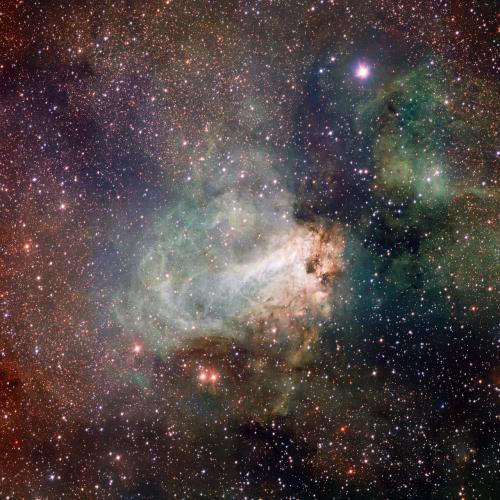
VLT Survey Telescope 268-megapixel camera


(PhysOrg.com) -- The VLT Survey Telescope (VST), the latest addition to ESO’s Paranal Observatory, has made its first release of impressive images of the southern sky. The VST is a state-of-the-art 2.6-meter telescope, with the huge 268-megapixel camera OmegaCAM at its heart, which is designed to map the sky both quickly and with very fine image quality. It is a visible-light telescope that perfectly complements ESO’s VISTA infrared survey telescope. New images of the Omega Nebula and the globular cluster Omega Centauri demonstrate the VST’s power.

Read more….

Image credit: ESO/INAF-VST/OmegaCAM. Acknowledgement: OmegaCen/Astro-WISE/Kapteyn Institute

Thursday, June 02, 2011

Post-Mortems at HubSpot

What I Learned From 250 Whys by Dan Milstein at HubSpot. This is quite good and worth reading!

I've learned about how HubSpot's systems work, why they sometimes break, and what we can do to make them more resilient. Beyond that, I've learned a lot about complex systems and failure in general. Which, in case you're wondering, is a fascinating topic. I highly, highly recommend Richard Cook's essay “How Complex Systems Fail” in O'Reilly's Web Operations. Or Atul Gawande's Complications and Better. Or basically anything John Allspaw writes.

If you'd like to build resilient systems, here's some of what I've learned from the fifty-plus 5 Whys I’ve been a part of. (And by &rlquo;systems,” I mean systems of people + machines, and by “resilient,” I mean I'm stealing from Allspaw.)

Sunday, May 29, 2011

Weighted Random Selection in Python

This morning I was looking for a Python implementation of weighted random selection, i.e., I have a set of weighted items and I want to randomly select one where the probability of selecting each item is proportional to its weight.  I found this blog post by Eli Bendersky which exposes a set of approaches nicely.

Friday, May 27, 2011

New Redshift Record of 9.4


Gamma ray observations of the gamma ray burst object GRB 090429B supplemented by infrared observations from the Gemini North telescope and United Kingdom Infra Red Telescope, both on Mauna Kea, place the object at a redshift of z=9.4, as reported by Emily Baldwin at Astronomy Now.  (Also at Cosmos by Miles Gough).

In the cosmological model, that would mean the scale of the universe was 9.6% of it's current size at the time the gamma rays and IR were emitted.    (1 / z + 1).

Also, see:  Cosmological Distances and Gains of Salt

Image credit: Gemini Observatory / AURA / Levan, Tanvir, Cucchiara.

Monday, May 23, 2011

Google Social Puzzle Pieces

By David Goldman at CNN Money.

Change Your Facebook Password

Access to your account may have leaked.  This discovered problem means it's been possible for others to access your account since 2007 via third-party applications.

The best thing to do is change your password as soon as possible.  That will invalidate any leaked tokens if they were in the possession of any evil doers.

More information is in this article at Symantec.

This is also explained in this installment of Security Now.  Skip ahead to the 58-minute mark.

P.S.  Note that you will have to enter your new password to third party apps you're using after doing this.  For example, on my Android phone I cleared the data and entered my email address and new password into the Facebook app.